Google has announced Google Antigravity 2.0, a standalone desktop application for working with AI agents across macOS, Linux, and Windows. The announcement arrived during Google I/O 2026, alongside a wider Antigravity ecosystem of CLI, SDK, API, enterprise, and model updates.
The important change is structural. Antigravity 2.0 is not simply the old Antigravity IDE with more features. Google describes it as a new, separate desktop application with no IDE, built around conversations, projects, artifacts, scheduled tasks, and multi-agent management. Developers can still keep the Antigravity IDE, but Google says the agent-first surface is moving into its own product.
Details are still relatively sparse, so this article sticks to Google's own announcements rather than third-party speculation. The short version for business readers: this is Google positioning Antigravity as an operating surface for agentic workflows, not just another coding assistant.
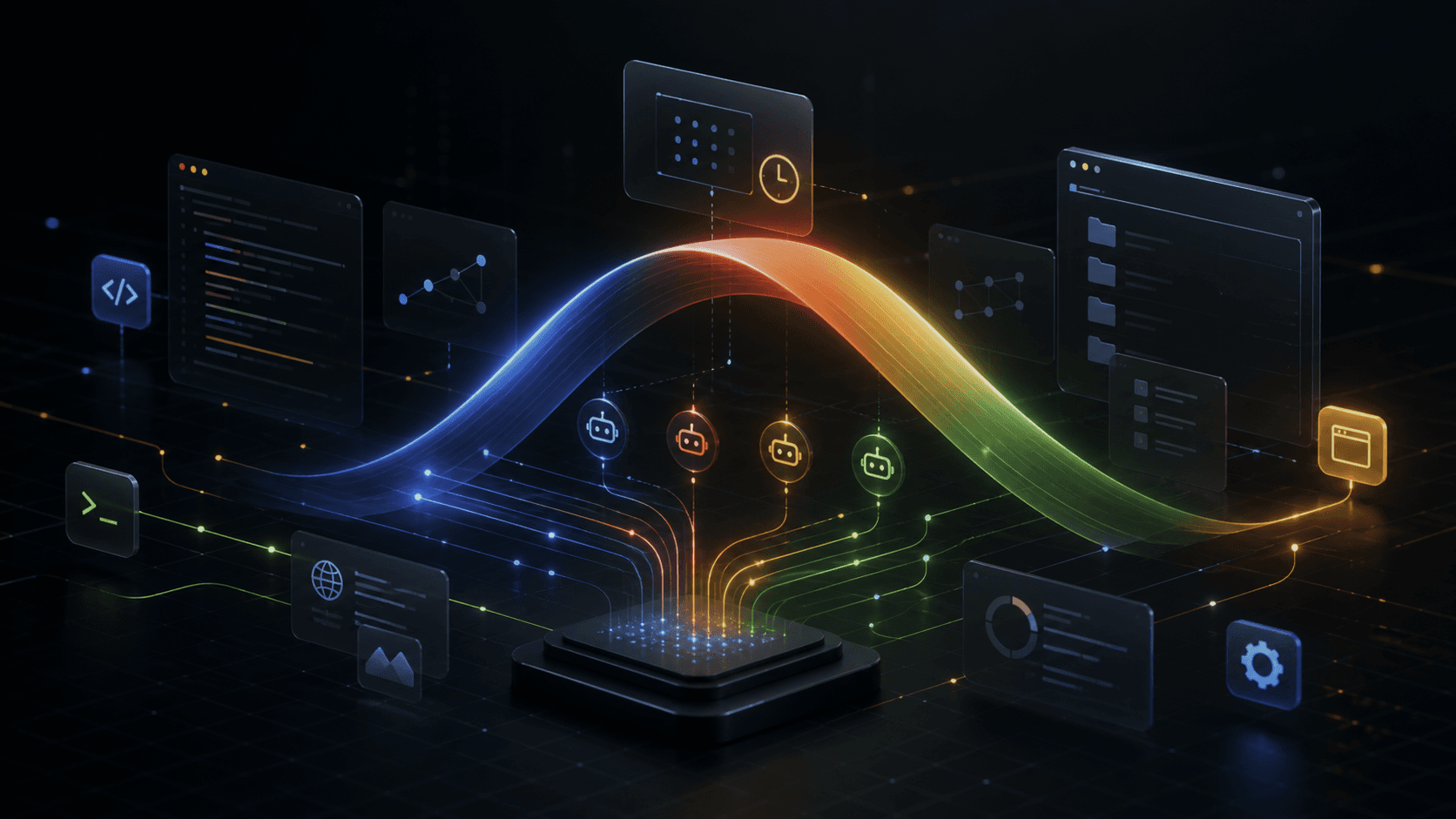
What has changed
Google's first Antigravity release was framed around an IDE with an Agent Manager surface. Antigravity 2.0 separates that agent manager idea from the code editor. The result is a desktop application where the primary object is not a repository or file tree, but a task, project, conversation, and artifact trail.
A standalone agent surface
Google says Antigravity 2.0 retains many of the principles of the IDE Agent Manager, but removes the tight coupling between agent and repository. Conversations are now grouped by project, and a project can span multiple folders with its own settings and permissions. That matters because a real business task rarely sits neatly inside one code repository.
Dynamic subagents
The main agent can define and invoke subagents for focused subtasks. Google's explanation is practical: subagents avoid overloading the main agent's context window and allow parallel work. In business terms, this is a move towards a multi-agent system where parts of a problem can be researched, implemented, checked, and reviewed at the same time.
Asynchronous task management
Long-running work can now continue in the background, rather than blocking the active conversation. This is a subtle but important product shift. If an agent is installing dependencies, running checks, or delegating to subagents, the main experience should not freeze around that one operation.
The key point
Antigravity 2.0 is best understood as an agent orchestration desktop app. The IDE still exists, but Google's new emphasis is on running and managing agents across projects, schedules, artifacts, and tool surfaces.
New controls and interaction patterns
The most business-relevant features are not only the model improvements behind the scenes. They are the controls Google is adding around how agents are invoked, scoped, and steered.
Scheduled Tasks
Antigravity 2.0 introduces Scheduled Tasks, where users can define cron-like schedules that invoke agents automatically. Google gives examples such as recurring checks and background work. This turns the agent from a tool you prompt manually into something closer to an automation pipeline with a conversational interface.
Slash commands
Google lists several new slash commands, including /goal, /grill-me, /schedule, and /browser. The last one is particularly telling: Google says browser use is now controlled explicitly because agents were not always reliable at deciding when to use browser primitives on their own.
Hooks and permissions
JSON hooks allow users to intercept parts of an agent's behaviour. Projects can also carry scoped settings and permissions. For organisations considering agent adoption, those controls matter as much as raw capability. The problem is rarely whether an agent can do something once; it is whether the agent can be constrained, reviewed, and repeated safely.
Live voice transcription
Voice input now uses live transcription through Gemini Audio models, rather than passing a raw audio file into the model. Google positions this as a faster input method for prompts, with users able to edit the transcription before sending.
Why the I/O announcement matters
Google's I/O post puts Antigravity 2.0 inside a broader ecosystem. Alongside the desktop app, Google announced Antigravity CLI, Antigravity SDK, an Antigravity agent through the Gemini API, availability through Gemini Enterprise, and Google AI Studio Build export into Antigravity. That combination matters because it gives Google more than one route into the same agent harness.
Google also says Gemini 3.5 Flash is now the default Gemini Flash model on Antigravity, and describes it as its strongest agentic and coding model so far. The company published benchmark figures in the I/O post, but those are vendor-reported and should be treated accordingly until independent evaluations catch up.
The strategic signal is clearer than the product detail. Google is aligning model development, developer tools, local desktop workflows, enterprise access, and programmable API access around agents. That is materially different from releasing another chat interface.
What businesses should watch
For most organisations, Antigravity 2.0 should be evaluated less as a direct productivity claim and more as a sign of where agent tooling is going. The emerging pattern is clear: users set goals, agents plan and execute, artifacts communicate progress, and humans steer the work through review, feedback, permissions, and scheduled follow-up.
Governance before autonomy
Scheduled agents, background subagents, hooks, browser control, and project-level permissions are all governance questions. Any business trial should define what the agent can access, what it can change, where a human-in-the-loop is required, and what evidence the agent must leave behind.
Prompt quality still matters
The new /grill-me command is a useful admission that strong agent work still depends on clear instructions. For business teams, prompt engineering is not a gimmick. It is the work of turning a vague request into a testable brief, with context, constraints, and acceptance criteria.
Browser use is powerful but sensitive
Google's explicit /browser command reflects a real risk area. Computer use agents can operate software in ways that APIs cannot, but they also need tighter boundaries, logs, and verification. For regulated or operationally sensitive work, browser-enabled agents should start in low-risk environments.
Owlpen and Google Antigravity 2.0
Google Antigravity 2.0 is not currently available inside the Owlpen platform. It is a separate Google desktop product, aimed primarily at people working directly with agents, code, projects, and local development environments. Owlpen remains focused on business workflows such as document analysis, cost visibility, operational reporting, and controlled AI adoption for client teams.
The overlap is conceptual rather than product-level. Both platforms reflect the same market movement: AI is moving from one-off answers towards tool use, recurring tasks, artifacts, and multi-step execution. The implementation choices, data pathways, governance model, and user experience are different.
Not in Owlpen
Antigravity 2.0 is not an Owlpen integration and is not exposed as an Owlpen feature. Clients interested in Google's desktop agent product should evaluate it directly with Google's own documentation, licensing, security, and data-handling terms.
If you would like to discuss how agentic AI, workflow automation, or the Owlpen platform could support your business, contact us at enquiries@coaleypeak.co.uk or read more about the Owlpen platform.
Disclaimer. This article is published by Coaley Peak Ltd for general informational purposes only. The views expressed are those of the author, Stephen Grindley, and do not constitute legal, regulatory, financial, or technical advice. Nothing in this article should be relied upon when making procurement, investment, compliance, or technology decisions. References to third-party products, platforms, and companies are for informational purposes only and do not constitute endorsement. Product, benchmark, pricing, and availability claims cited are those reported by Google and have not been independently verified by Coaley Peak. Readers should seek independent professional advice appropriate to their specific circumstances. Information was accurate to the best of the author's knowledge at the date of publication. Coaley Peak Ltd and Stephen Grindley accept no liability for any loss or damage arising from reliance on the contents of this article.